Rococo to go

I have long been a fan of the Rococo - that peculiar stylistic trend that amplified the excesses of the Baroque with a frilly twist of its own in the mid to late 18th century. As a teenager on a trip to Paris with my family, I remember being totally transfixed by the painting of the pierrot, sometimes called Gilles, by Watteau in the Louvre. My gauche 15 year old self seemed to find some empathy in the forlorn looking clown caught between regret and apprehension.

My pleasure in the Rococo was always a slightly guilty one. The criticism it has often attracted as elitist, illogical, even degenerate was always difficult to deny. This prejudice, I am now learning, was in part, an Enlightenment plot to obscure the agency of female patrons and artists as instigators of style and taste. So I was eager to visit the Marie Antoinette exhibition at the V & A last Saturday. I even noticed an advert on the train to London which used the image (& discount code) of the Queen of Rococo to sell beauty products.
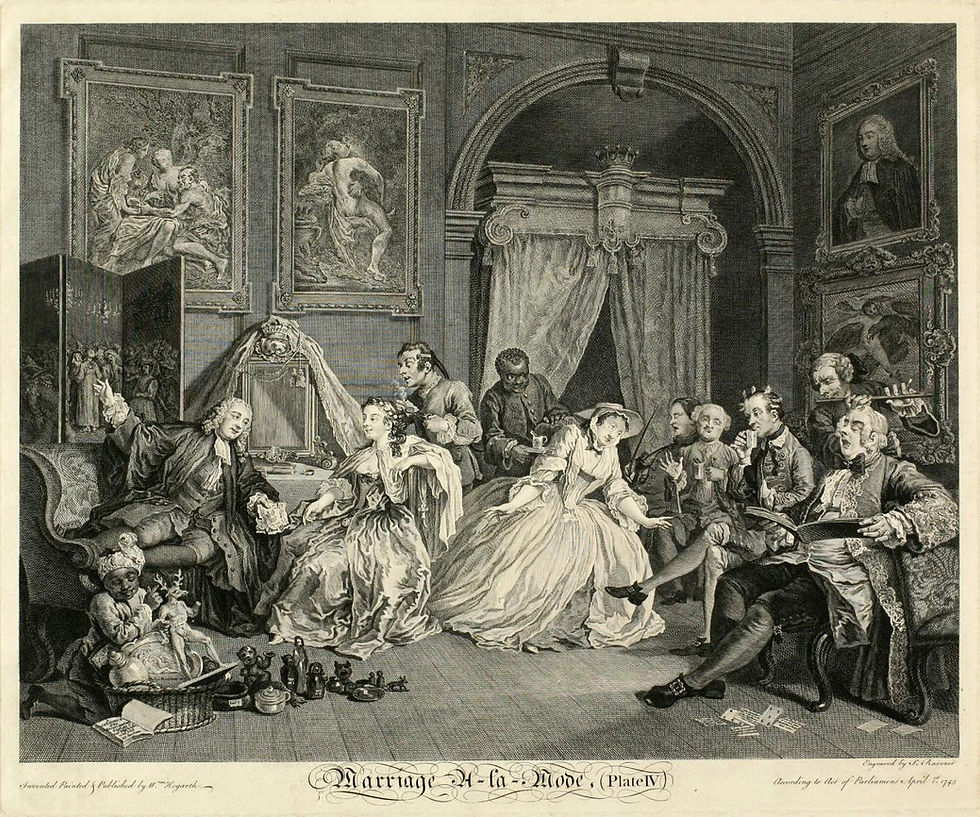
This association isn’t at all far fetched. Denigrated as le maquillage, (make up), Rococo was not only emblematic of female self-improvement but also reflected a shift towards effeminacy among the upper echelons of male society. ‘La Toilette’, the hours-long ritual of getting dressed in the morning in one’s private apartments, became a pseudo court during which political and cultural matters were debated at length amongst the movers and shakers, male and female, of the age.
That old English rogue, William Hogarth, put his characteristically barbed spin on what he saw as this continental preening practice in the third plate of his Modern Moral Subject series, Marriage a la Mode.
Style and taste had long been defined by women at the court of the French Bourbon kings of the 18th century. Usually it was the royal mistresses who dictated the fashions of the day but that all changed with the arrival of the ‘Teen Queen’ of the future Louis XVI, Marie Antoinette. At first vilified for her naivety & she soon set the standard for luxury and jaw-dropping trends in clothes and accessories. She also raised up women; female artists, designers and stylists, regarding their talents as equal, if not superior to men.

One of her most preferred artists was Elizabeth Vigee Le Brun. Not born into wealth, Le Brun was denied access to the French Academy of Art until an intervention by MA.
This female preferment fomented male resentment and jealousy, expressed in the most toxic sexual slurs against both Le Brun and the Queen. Following the execution by guillotine of MA, Le Brun fled to the Imperial court of Russia where she was once again feted for her elegant portraits of the rich and famous.
Marie Antoinette’s excesses are undeniable but more sympathetic research has asserted that her appetite for shoes & diamonds was a mere drop in the ocean compared to the cost of wider (male-driven), political mismanagement in France. But everyone loves a scapegoat and if she’s female, so much the better - iterations of Marie Antoinette’s name have been used to demean wives of powerful men, from Cherie Blair to Carrie Johnson.

The exhibition literally dazzles - the diamonds on display are breathtaking and on a scale that Elizabeth Taylor could only dream of. The fabrics are stunning - there’s what must be the first iteration of animal print alongside pastel stripes, beautiful embroidered and painted silks and my personal favourite, the exquisitely woven Toile de Jouy.
MA took a special interest in the manufacture and design of this distinctive cloth. She even had garments made from T de J to wear in prison - what a Queen she was!
In the final room a glorious confection of shoes and dresses reinforce the style icon MA has been to so many of the leading designers and performers from the last 200 years. From Dior to Vivienne Westwood, from Grace Kelly to Rihanna.
I went straight from the V&A to the Design Museum to see the Archives of film director, Wes Anderson. Anderson’s films could definitely not be described as gritty. Often whimsical, they exude a kind of yearning for something elusively out of reach. They are drawn from memories, animated with a sense of affection for the misfit and the inner child.

I wasn’t expecting any associations with the Rococo but I was reminded of Watteau again as I moved through the meticulously curated exhibition. Watteau’s great innovation was the ‘fete gallante’ subject - groupings of elegant, almost ethereal figures in dream-like settings, blending fantasy with reality. Anderson, too, conjures up highly artificial, story-book worlds, with restricted colour palettes that are almost characters in themselves. Many of these palettes could have been taken from the world of Marie Antoinette. Sugared almond pink and ‘Chateau Grey’ for the Grand Budapest Hotel, macaron hues for the vending machines in Asteroid City.


I’m not suggesting that Marie Antoinette provides us with a design for life but we all deserve a bit of luxury now and again. If not a yard of diamonds, an iced cupcake will do.


Comments